
The $150 Billion Fat Scam
How Industrial Waste Became "Heart-Healthy" Food

The average Australian is currently 18% "industrial sludge" by weight. It takes 680 days for a single hot chip’s worth of seed oil to leave your system. Your cells are literally rusting from the inside out.
Here is a graph that shouldn’t exist.
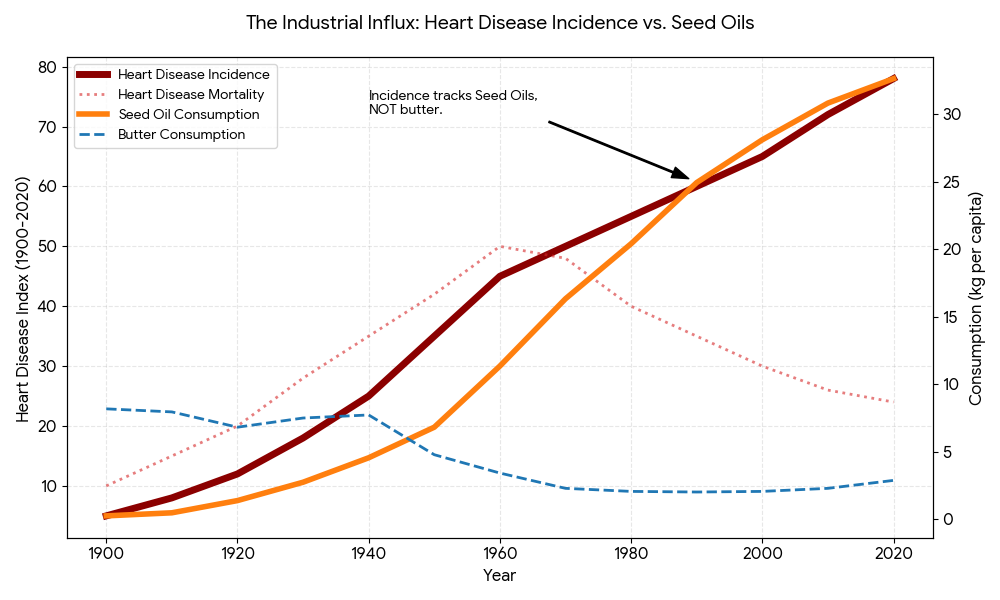
Heart disease killed fewer than 10% of Australians in 1900. By the 1960s, it was the nation’s leading killer. If you plot those deaths against butter consumption, the lines move in opposite directions. We ate nearly 8kg of butter per person in 1900 (low heart disease). We eat roughly 2.8kg today.
Now, plot it against “vegetable oil.” In 1910, it didn’t exist in our shops. By 2026, the average Australian consumes over 32kg annually. The “heart-healthy” advice of the last 50 years—the era of the Heart Foundation Tick—didn’t just fail. It backfired.
The experts will point to falling death rates as proof of success. Don’t be fooled. We didn’t solve heart disease; we just bought more time with expensive drugs and emergency surgery.
Look at Incidence (the solid red line). The number of Australians being diagnosed with heart disease is higher than ever. As the “Mortality” line (deaths) falls due to medical intervention, the “Incidence” line (sickness) tracks the rise of Seed Oils with near-perfect precision.
The “heart-healthy” advice of the last 60 years told us that saturated fat causes heart disease. But as the butter disappeared from Australian tables, the sickness didn’t stop, it accelerated. The only thing that tracks the actual rise in cases is the 3,000% increase in industrial seed oil consumption.
1911: From Engine Lubricant to Dinner Table
Before 1910, humans didn’t eat seed oils. Not because they were disciplined. Because the technology didn’t exist. You can’t squeeze oil from a sunflower or a canola seed by hand. It requires steel roller presses, hexane solvents, and industrial degumming. The first seed oil, from cottonseed, was a toxic waste product of the cotton gin, literally garbage that cattle wouldn’t eat because it caused respiratory illness.
Procter & Gamble had a mountain of this toxic sludge and a chemistry problem. Their solution was brilliant and horrifying. They figured out how to hydrogenate it into a solid that looked like lard. They called it Crisco.
The marketing campaign was one of the most successful in history. P&G gave away free cookbooks, thousands of them, to churches and women’s groups. Every recipe called for Crisco. They framed traditional animal fats as “unhealthy” and their industrial waste product as “pure” and “modern.”
In Australia, the explosion came with the demonisation of “saturated fat.” We were told to bin the dripping (tallow) and the butter in favour of Margarine, a spread made of industrial seed oils that was originally developed to fatten poultry.
The “vegetable oil” industry was born from a need for profit, not nutrition. It allowed companies to turn a cheap agricultural byproduct into a “premium” health product.
The Chemistry of Rust
Why do seed oils behave differently than the tallow your grandmother used? It comes down to molecular stability.
Fat molecules are chains of carbon atoms. Saturated fats (butter, tallow) are “saturated” with hydrogen. They’re straight, stable chains. They don’t react with oxygen easily. They’re solid at room temperature because they stack neatly, like bricks.
Polyunsaturated fats (seed oils) have multiple “double bonds”, kinks in the chain. These kinks make the molecules unstable. They’re liquid at room temperature because they can’t stack properly. More importantly, they react violently with oxygen.
When you heat a seed oil - say, in a frying pan or during the industrial refining process - it oxidizes. The chemical structure breaks down, creating free radicals and toxic aldehydes. One of the worst is 4-hydroxynonenal (4-HNE), a molecule so reactive it damages DNA, proteins, and mitochondria.
Your body stores fat for energy. When you eat oxidized seed oils, that “energy” behaves like rusty metal in your tissues. It takes 600-680 days for half of the linoleic acid you eat today to leave your body. During those two years, that fat is “rusting” inside you, creating inflammation and scrambling metabolic signals..
You aren’t just what you eat. You’re the cumulative oxidation products of what you ate for the last three years.
The Biological Mechanism
Why does this matter metabolically?
Your cell membranes are made of fat. The ratio of omega-6 to omega-3 in those membranes determines how they respond to hormonal signals.
Humans evolved with a 1:1 ratio. Modern Australians have at least a 15:1 ratio. This isn’t just “inflammation.” It’s a scrambling of cellular communication.
When inflammatory cytokines arrive at a cell wall flooded with omega-6 fats, the signal amplifies. When insulin arrives, the signal blunts. You become simultaneously inflamed and insulin resistant. Your body thinks it’s starving while it’s storing fat.
Mitochondria, the engines of your cells, burn fuel less efficiently when membranes are packed with polyunsaturated fats. They produce more reactive oxygen species. You age faster. You recover slower. Your brain fog persists because 60% of your brain is fat, and if that fat is oxidized, your neurons misfire.
SIDEBAR: The Australian Receipts
The “Industrialisation” of the Aussie Cell
In 1900, the average Australian’s body fat was less than 3% linoleic acid. Today, it is 18–22%.
The 400% Surge: ABS data shows Australian production of oilseeds (Canola, Sunflower, Soy) has increased fourfold since the 1990s.
The Sydney “Smoking Gun”: The Sydney Diet-Heart Study showed Australian men who replaced butter with safflower oil had a 62% higher death rate than the butter group.
The Ratio Rupture: CSIRO research indicates our Omega-6 to Omega-3 ratio has shifted from an ancestral 2:1 to a toxic 15:1 (at least).
The Takeaway Trap: 34% of our food budget is spent “away from home,” where seed oils are used in over 95% of commercial fryers.
The “Sinister Six” vs. Ancestral Fuel
If a food requires an industrial refinery to exist, your body wasn’t designed to burn it.
You don’t need to become a carnivore. You need to become a temporal purist.
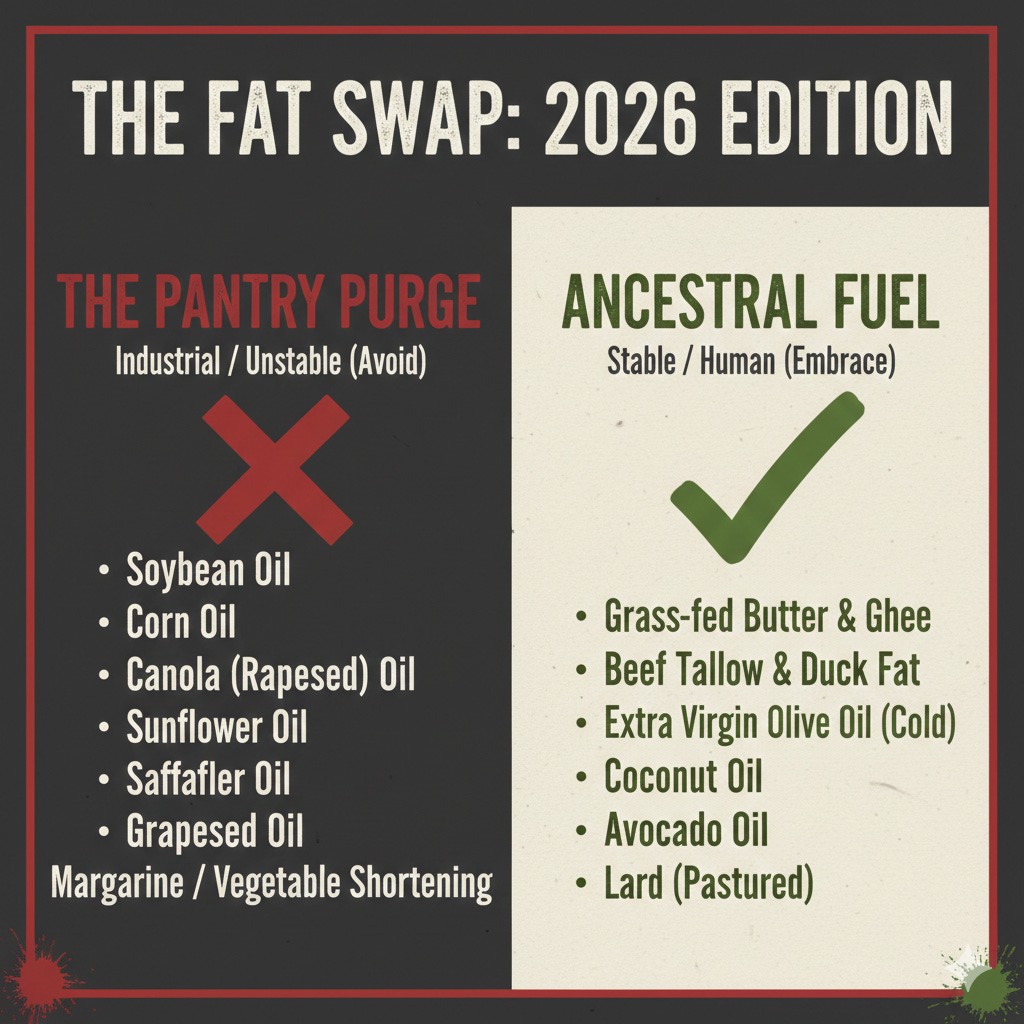
Eat fats that existed before 1911:
Butter from grass-fed cows (vitamin K2, stable saturated fats)
Beef tallow (high in stearic acid, which mitochondria burn efficiently)
Extra virgin olive oil (monounsaturated, low omega-6, but don’t heat it above 350°F)
Coconut oil (medium-chain triglycerides that bypass damaged metabolic pathways)
Lard (pastured), Duck fat, schmaltz (ancestral calories that don’t oxidize in your arteries)
Stop eating oils that require an industrial refinery:
Canola, soybean, corn, sunflower, safflower, grapeseed, rice bran, “vegetable oil” blends
Read labels. If a packaged food lists one of these, it’s not food. It’s a shelf-stable industrial product designed to maximize profit margins, not human metabolic function.
When eating out, ask what oil they use. If the answer is “vegetable oil” or “canola,” understand that you’re consuming lipid peroxides, fat that has started to rust before it even hits your mouth.
The Restoration
You aren’t just what you eat; you are the cumulative oxidation of what you’ve eaten for the last 680 days. But you can reverse the damage.
By cutting out the Sinister Six and returning to the stable, ancestral fats that Australians ate a century ago, your “cellular rust” clears. Energy returns. Brain fog lifts. Inflammation drops.
The solution isn’t a new-age diet. It’s a return to common sense. Eat like it’s 1899.
THE PANTRY CHALLENGE: Go to your kitchen right now. Pick up your “healthiest” packaged snack. If the label says Vegetable Oil, Sunflower, or Canola, bin it.
I’ve put together a 2026 Australian "Safe List" of specific supermarket brands (Coles, Woolies, and Harris Farm) that are 100% seed-oil free, plus a 2-Year Detox Protocol to drain the sludge from your system.
Subscribe below to unlock the Australian Shopping Guide and the 2-Year Detox Protocol.
