
The Great Sunscreen Deception
Mandatory school sunscreen breaks would be a triumph of good intentions over biological reality - and a high-stakes experiment on our children’s endocrine systems.

The call is growing louder for a new ritual in the Australian schoolyard. Prompted by the heartfelt advocacy of palliative care doctors who have witnessed the devastating end-stage of skin cancer, schools are being urged to implement mandatory “Sunscreen Breaks.” On the surface, it is a story of communal protection, a compassionate response to a deadly disease. But beneath this push for policy lies a mystery that has been brewing for a hundred years: the more we have hidden from the sky, the more melanoma has thrived in the shadows.
The Mystery of the 1930s
The statistical trajectory of melanoma since the early 20th century presents us with a striking, geometric impossibility. In 1930, the lifetime risk of an Australian or American developing melanoma was approximately 1 in 5,000. By today’s standards, that risk has surged toward 1 in 33 for some demographics. To accept the standard narrative, one must believe that we are living through an epidemic caused by a sudden, massive increase in sun exposure. Yet, any student of history knows that the humans of 1930 were vastly more exposed to the sky than we are today.
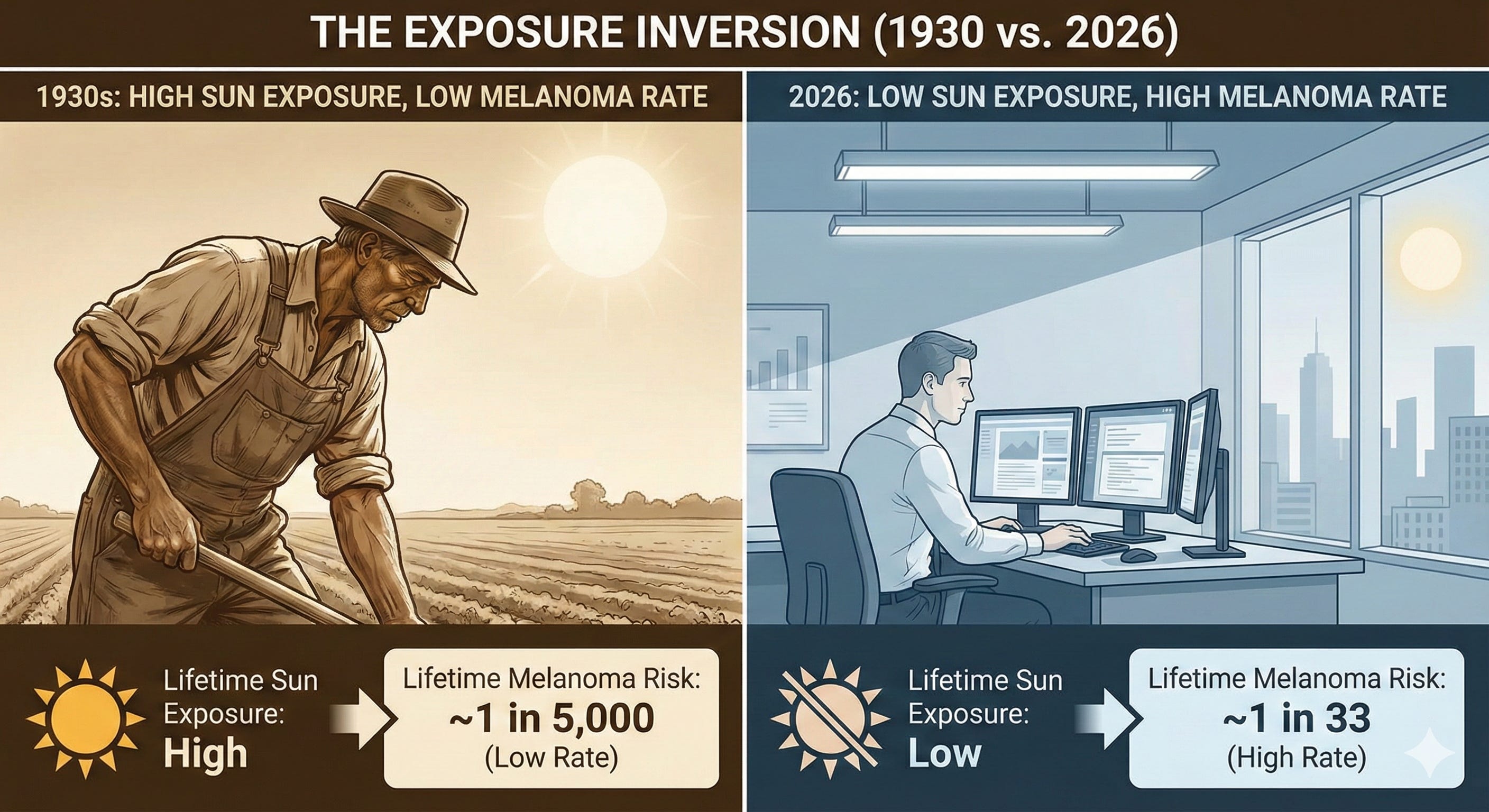
They lived in the era of the verandah, the open-air market, and the manual laborer, long before the “indoor-industrial” complex of office work and air-conditioned bubbles. If the sun were the primary driver of this 2,000% increase, the farmers of the Great Depression should have been the most cancer-stricken generation in history. Instead, the opposite is true. This divergence suggests that melanoma isn’t merely a “burn” disease; it is something more systemic and more elusive.
The Biological Disconnect: Why the Sun Isn’t the Smoking Gun
If we look past the public health slogans, the link between sunlight and melanoma begins to look remarkably fragile. Unlike common basal cell or squamous cell carcinomas, which appear almost exclusively on sun-damaged, weathered skin, melanoma is a frequent traveler to the body’s dark places. It appears on the soles of the feet, the palms of the hands, and the mucosal surfaces—areas that rarely, if ever, see a photon of light. This Anatomical Paradox suggests we are looking at a disease of systemic mutation rather than simple surface radiation.
Even more damning is the Occupational Paradox. Data consistently shows that those who work outdoors have a significantly lower risk of melanoma than those who work indoors. If UV radiation were a simple poison, the lifeguard should be more at risk than the accountant. The fact that the opposite is true points toward a protective element of sunlight—specifically the synthesis of Vitamin D and the body’s natural solar habituation—that we would effectively neutralize with mandatory chemical barriers.
The UVA “Open Door” and the Oxidation Trap
When sunlight does play a role in skin damage, the true danger lies in oxidation rather than the sun itself. High-energy UVA rays penetrate deep into the dermis. There, they generate Reactive Oxygen Species (ROS) that can interact with cellular lipids—like the polyunsaturated fatty acids (PUFAs) dominant in modern diets—to trigger deep-tissue DNA damage.
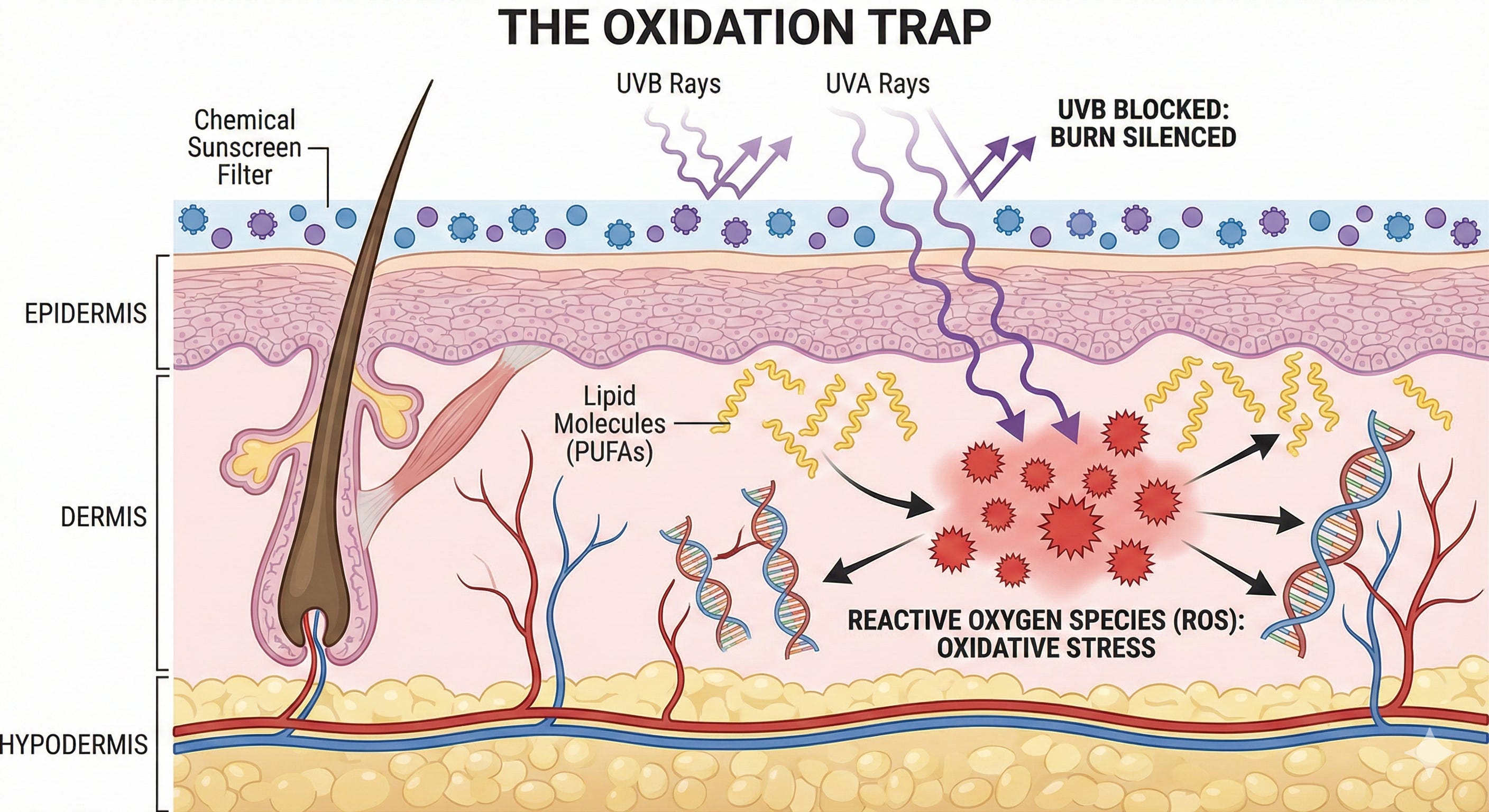
The great irony of the sunscreen era is that early formulations focused almost exclusively on blocking UVB, the rays that cause the warning signal of a burn. By silencing this natural alarm while leaving the “door” open for UVA to saturate the deeper layers of the skin, we inadvertently increased the total dose of oxidative radiation. While modern “Broad Spectrum” mandates attempt to address this, the fundamental problem remains: we are encouraging children to stay in the sun for hours longer than their biological threshold would permit, creating a massive dose of radiation the body never evolved to process.
Numbing the Alarm: The Behavioural Trap
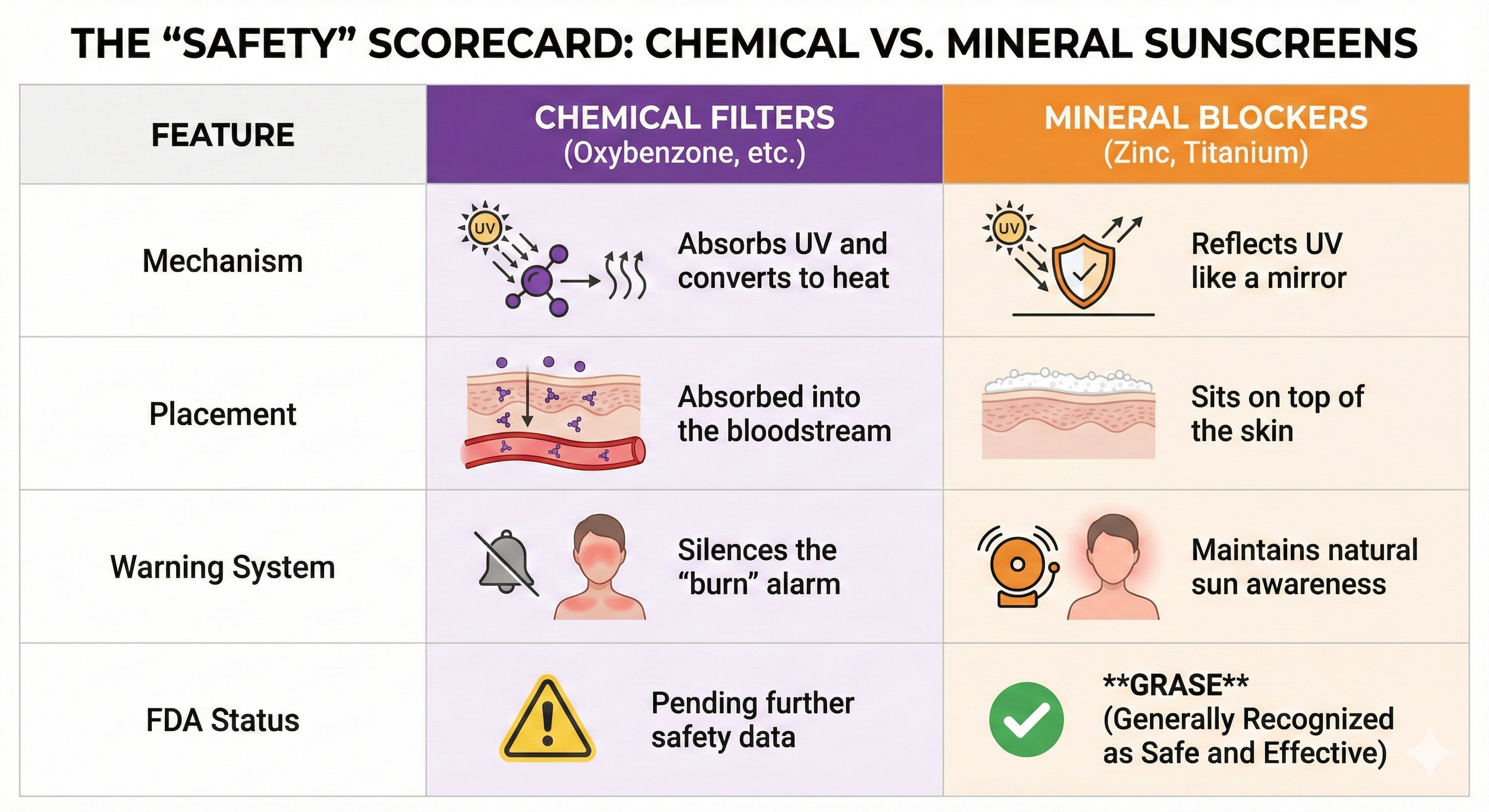
Perhaps the most significant behavioural danger is how these chemicals numb the skin’s natural warning system. By suppressing the erythema (sunburn) response, chemical filters allow individuals to stay in the sun for hours longer than their biological threshold would permit. This leads to massive doses of radiation—and potentially massive doses of systemic chemicals—that the body never evolved to process simultaneously.
We have replaced a biological hard-stop with a chemical false sense of security.
The Chemical Transfusion: Beyond the Inert Barrier
This brings us back to the classroom and the call for mandatory “slop” breaks. We treat sunscreen as if it were an inert suit of armor. But the biological reality is far more invasive. In 2019 and 2020, the US FDA published landmark studies in JAMA confirming that common chemical filters like avobenzone, oxybenzone, and octocrylene enter the bloodstream after just a single application.
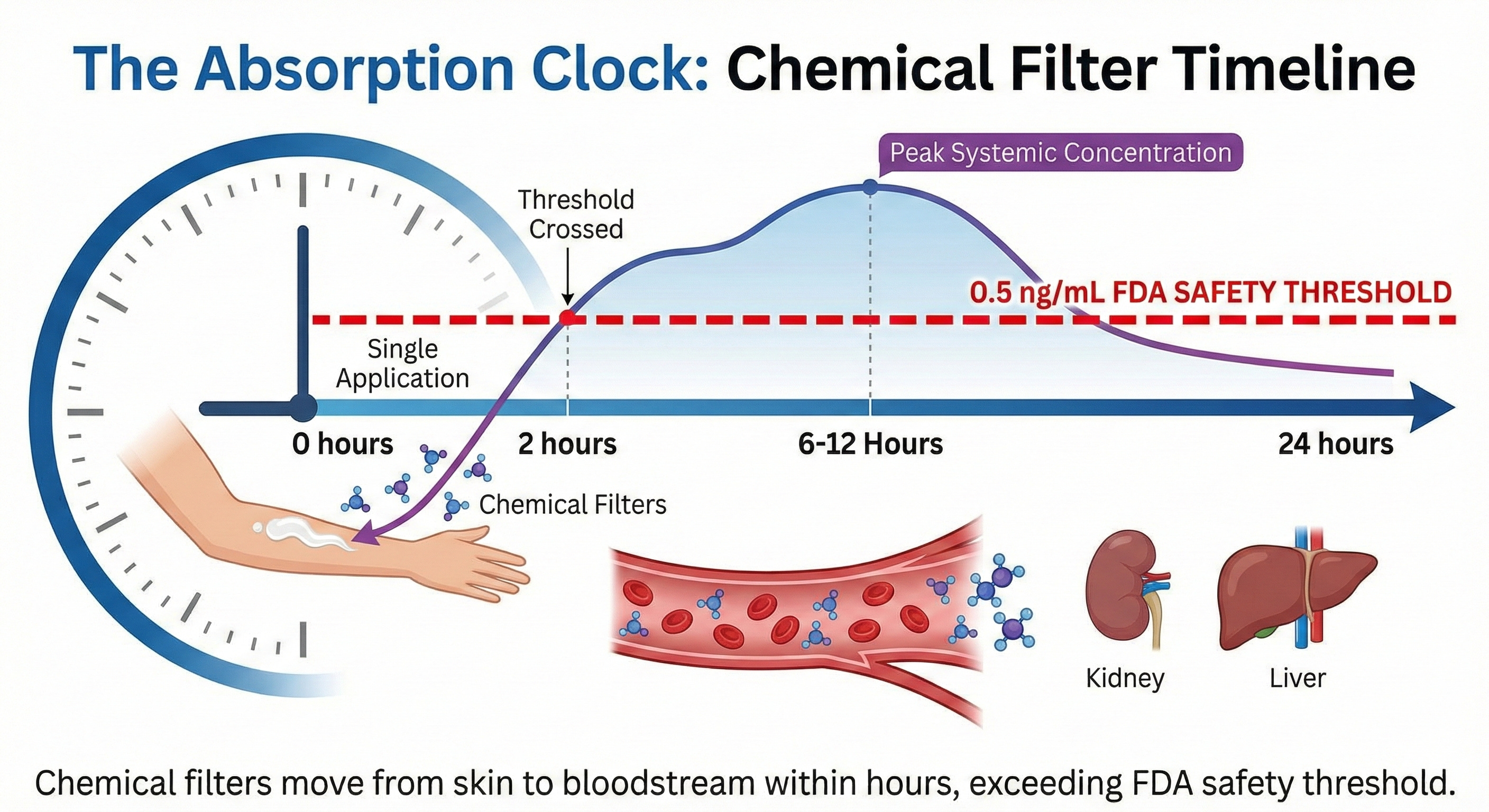
These chemicals were found at concentrations exceeding 0.5 ng/mL—the “Threshold of Toxicological Concern.” This is the specific level at which the FDA requires further safety testing to rule out carcinogenic or developmental risks. The concern is particularly sharp regarding Oxybenzone (Benzophenone-3), a known endocrine disruptor that acts as a weak estrogen.
Our own Therapeutic Goods Administration (TGA) caught up to this reality in 2025. Following a comprehensive safety review, the TGA recommended that brands using Oxybenzone and Homosalate reformulate to lower their concentrations. The review identified that these specific chemical filters had a Margin of Safety (MoS) lower than preferred for the kind of heavy, frequent use being proposed for our schools. Because these chemicals are lipophilic, they linger in fatty tissues, leading to a persistence where they have been detected in 97% of human urine samples and even in breast milk.
The Safer Path Forward
The path forward is not to ignore the sun, but to respect it. If we must use barriers, we should look toward Mineral Alternatives like Zinc Oxide and Titanium Dioxide. These are currently the only two ingredients listed by the FDA as GRASE (Generally Recognized as Safe and Effective). As physical blockers, they stay on the skin surface, providing a “shield” without the blood-stream absorption profile that defines the chemical era.
We are being asked to trade the ancient, predictable heat of the sun for the silent, systemic uncertainty of the laboratory. In the rush to “do something” about the Australian summer, we risk numbing our children’s natural warning systems and replacing them with a chemical shield that enters the blood and lingers for weeks.
We are teaching a generation to fear the sky while trusting a bottle of endocrine disruptors.
It is time to recognize that you cannot protect a child by drowning their biology in a shadow of our own making.
Subscriber Only: The Pharmacy Field Guide
When you walk into a chemist or supermarket in Australia, you are greeted by a wall of bright, clinical-looking bottles promising “Maximum Protection.” But for the discerning parent, the real story is written in the fine print of the active ingredients list. Navigating this landscape requires moving beyond the SPF number and looking at the molecular reality of what is being absorbed into your child’s skin.
